Fire hoses are hoses used to transport high-pressure water or fire-retardant liquids such as foam. Traditional fire hoses are lined with rubber and wrapped with a braided linen outer surface. Advanced fire hoses are made of polymer materials such as polyurethane. There are metal joints at both ends of the fire hose, which can be connected to another hose to extend the distance or a nozzle to increase the liquid spray pressure.
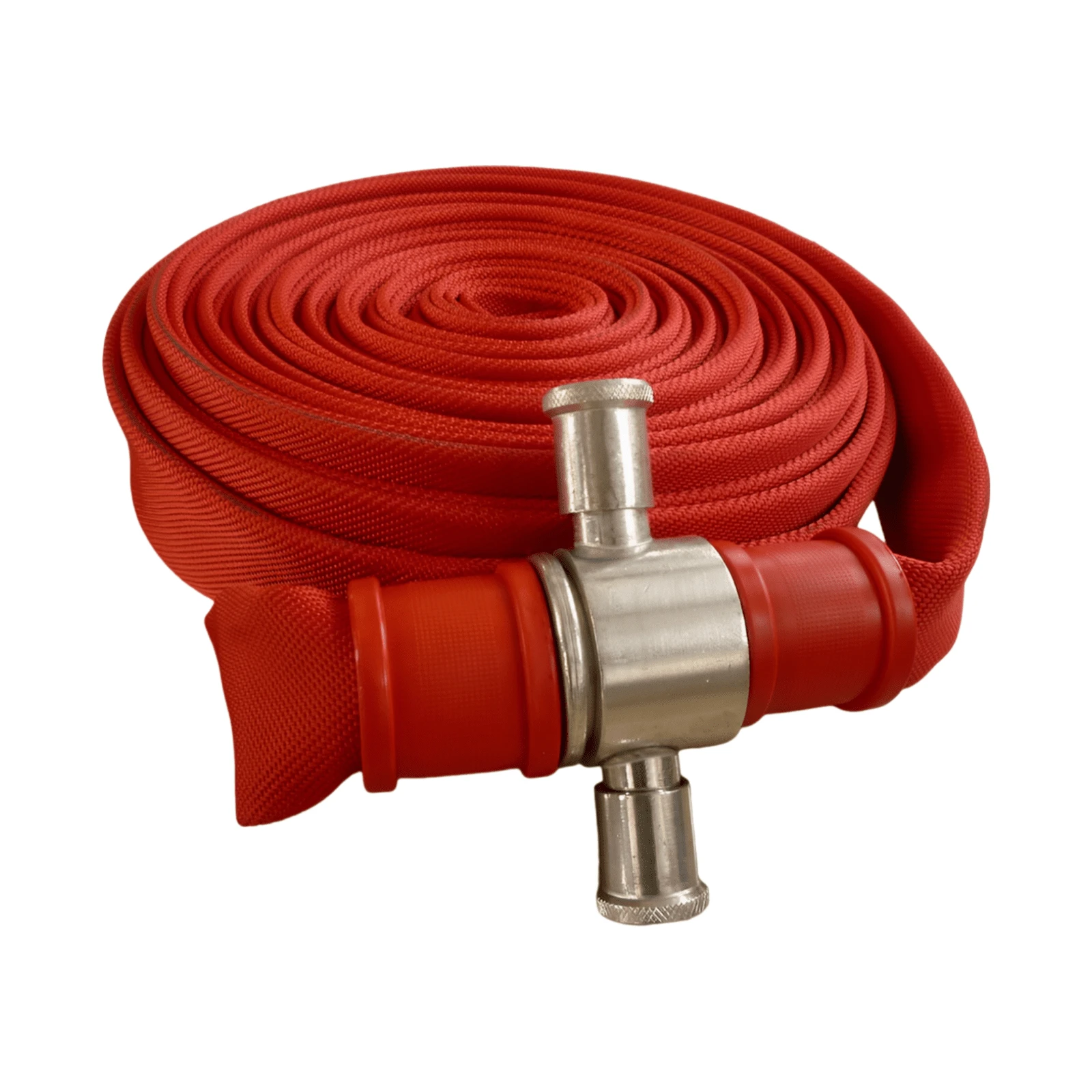
65mm x 30m Red Lay Flat hose

1 inch fire hose

3 inch fire hose
Classification
Fire hoses are divided into two categories: lined fire hoses and leaking fire hoses. Lined fire hoses include rubber fire hoses, TPU fire hoses, polyester glue-filled hoses, and hemp plastic-coated hoses. According to the working pressure, it is divided into four categories: 0.8MPa, 1.0MPa, 1.3MPa and 1.6MPa. According to the diameter, it is divided into four categories: 50, 65, 80 or 75, 90 mm. According to the weaving method, it is divided into two categories: plain weave water belt and twill water belt. The length of each water belt is generally 20 meters. .
Water hose maintenance
① Management. It is necessary to implement dedicated management, classify according to quality, number and register, and keep abreast of the quality and use of water belts. Establish and improve the water belt maintenance system, and regularly educate all employees to consciously comply with it.
② Storage. A special storage location or storage room should be set up. For long-term storage of spare hoses, a place with moderate temperature and ventilation should be selected. The hoses should be rolled up in a single layer and placed on a stand, and should be turned twice a year or exchanged and folded once. The vehicle hoses should avoid rubbing against each other, and the edges should be exchanged if necessary.
③Aspects of use. When laying, avoid sudden twists and turns, avoid forcibly dragging on the ground after filling with water, and avoid contact with corrosive chemicals such as oil, acid, alkali, etc.; in areas where there may be flames or strong radiant heat, cotton or linen water should be used When laying water hoses at high altitudes, use water hose hooks; when passing railways, pass under the rails; when passing roads, use water hoses to protect bridges; prevent water hoses from contacting hard objects with edges and corners; do not use water hoses when demolishing buildings. Throw wooden boards, steel parts and other items onto the water belt; clean the water hose after use; use lined hoses when laying water hoses outside buildings in cold areas.
④Repair. If any holes are found during use, they should be bandaged with cloth in time to prevent the holes from expanding. Mark them and repair them promptly after use. It should be inspected frequently and repaired in time if any damage is found.

15 fire hose

fire hydrant hose

65mm x 30m Red Lay Flat hose
What are the fire hose accessories? What are their uses?
Fire hose accessories include hose wrappers, hose hooks, hose bridge guards, interfaces, water distributors, etc.
①Hose wrapping cloth is used to wrap the leaks of fire hoses and is one of the necessary accessories on fire trucks. Consists of parts such as canvas straps and metal clamps.
② The hose hook is a tool for hanging fire hoses. During firefighting, when laying the hose vertically to high places, the hose hook can be used to hang the hose on a ladder or other object, which can not only reduce the falling force of the hose, but also It is convenient for the water gunner to control the water gun to shoot water to extinguish the fire. The water hose hook is composed of canvas strap, metal hook and half ring.
③ The water belt bridge guard is used to protect the equipment that does not affect the normal movement of vehicles when the water belt is laid across the traffic artery. It has the characteristics of high strength, pressure resistance and durability, and easy to pack up.
④ There are many types of interfaces, including hose interfaces, pipe thread interfaces, reducing interfaces, special-shaped interfaces, threaded interfaces, etc. Used to connect water hoses to water hoses, fire hydrants, fire pumps, water guns and other spray devices. According to the structural form, it can be divided into internal buckle type, plug-in type and thread type.
⑤The purpose of the water distributor is, firstly, to separate two or more streams of water from one stream of water; secondly, it is used as a switch. With the help of the water distributor, the water flow can be turned on or off from the water belt line without going to the water pump. Switching is performed to shorten the time required to turn on and off the water flow and ensure water supply to the fire scene in a timely manner. There are three types of water distributors: two-way water distributor, three-way water distributor and four-way water distributor.
Use and maintenance of fire hoses:
First, the hose connection. When the fire hose is put on the hose interface, it must be padded with a soft protective material, and then tied tightly with galvanized iron wire or hose hoops.
Second, use of water hose. When using a fire hose, the high-pressure hose should be connected close to the water pump. The water-filled hose should be prevented from twisting or sudden bending, and the hose interface should be prevented from being damaged by collision.
Third, lay the water belt. When laying water hoses, avoid sharp objects and various oils. When laying water hoses vertically to high places, use hose hooks. When laying water hoses through traffic arteries, water hoses should be used to protect bridges and pass through railways. When moving, the water belt should pass under the track to prevent the water belt from being crushed by the wheels and interrupting the water supply.
Fourth, prevent freezing. In severe winter, when the water supply needs to be suspended on the fire ground, in order to prevent the water belt from freezing, the water pump needs to run at a slow speed to maintain a small water output.
Fifth, clean the water belt. After use, the water belt must be cleaned. The water belt that transports foam must be carefully washed to protect the glue layer. In order to remove the grease on the water belt, you can wash it with warm water or soap. For frozen water belts, you must first melt them, then wash and dry them. Undried water belts should not be rolled up and stored.
Precautions
Fire hose is a hose used to transport water at firefighting sites. According to the material, it can be divided into lined fire hoses and unlined fire hoses. Among them, unlined fire hoses have low pressure resistance, high resistance, are prone to water leakage, are prone to mildew and rot, and have a short lifespan, so they are suitable for laying in fire scenes inside buildings; lined hoses are resistant to high pressure, wear, mildew and rot, and are durable. It is durable, not easy to leak, has low resistance, can be bent and folded at will, and can be moved at will. It is easy to use and is suitable for laying outside fire scenes and connecting fire trucks.
When using fire hoses, please note:
1. Sudden twists and turns should be avoided during laying to avoid reducing the ability to withstand water pressure; twisting should also be avoided to prevent the hose from rotating after being filled with water and causing the internal buckle hose interface to disengage.
2. After filling with water, avoid forcibly dragging it on the ground. When you need to change the position, lift it and move it as much as possible to reduce the wear and tear between the water belt and the ground.
3. Avoid contact with corrosive chemicals such as oil, acid, alkali, etc.
4. Cotton or linen hose should be used in areas where there may be flames or strong radiant heat.
5. Clean it after use, hang the unlined hose in the sun, and store it in a cool, dry place after drying.
6. If any damaged holes are found during use, wrap them tightly with water tape and darn or glue them as soon as possible afterwards; when obvious damage occurs, you should withdraw from combat readiness immediately.
7. When vehicles need to pass through the water belt being laid, water belt bridge protection should be installed at the passing location in advance.
8. If you need to pass the railway when laying, you should pass under the railway track.
9. Lined hoses should be used on the outside of buildings in cold areas to prevent the hoses from freezing.
Fire hose accessories
Hose accessories mainly refer to the accessories necessary for connecting and using fire hoses, including interfaces, water distributors, etc.
1.Interface
The interface is the joint where the water hose is connected to the hose, fire pump, fire hydrant or mobile water monitor. Mainly include hose interface, pipe thread interface, valve cover, internal thread fixed interface, external thread fixed interface, reducing interface, special-shaped interface, etc.
Please note when using:
(1) When using and storing, avoid falling, bumping and heavy pressure to prevent deformation and making assembly and disassembly difficult.
(2) Before connection, the chute and sealing parts should be carefully checked. If there is sludge, sand and other debris, they must be removed in time to prevent assembly and disassembly difficulties and poor sealing.
(3) When connecting the internal buckle interface, insert the claw into the chute and then turn it fully clockwise. When connecting the hose, it is also necessary to straighten the hose to prevent the hose from twisting and causing the interface to detach on its own.
(4) When connecting the plug-in interface, you should insert it until you hear the sound of the spring pin of the female interface extending into the slot of the male interface to ensure a reliable connection.
(5) When storing, be careful to avoid contact with chemicals such as acids and alkalis to prevent corrosion of metal parts and deterioration of rubber seals.
2.Water separator
The water distributor is a connecting device that divides the water flow from the outlet line into the branch line water flow. According to the number of branch lines, it can be divided into two parts of water, three parts of water and four parts of water.
(1) Structure
Each water distributor has a water inlet and several water outlets, which can be used simultaneously or separately. The interfaces are all internal buckle types. The water outlets are equipped with stop valves or ball valves, which can be closed at any time to control the water flow and facilitate the addition and replacement of branch line hoses.
(2)Use and maintenance
Before use, check whether the interface seals and valves are complete and functional. In severe winter, we must try to keep it warm to prevent freezing failure. Rinse thoroughly with clean water after use.
Hot Tags: 2 inch fire hose, China, manufacturers, suppliers, factory, custom, price, for sale