Direct Manual Control, Space-Saving Design, and Heavy-Duty Performance

Side-Mounted Crank for Direct Operation
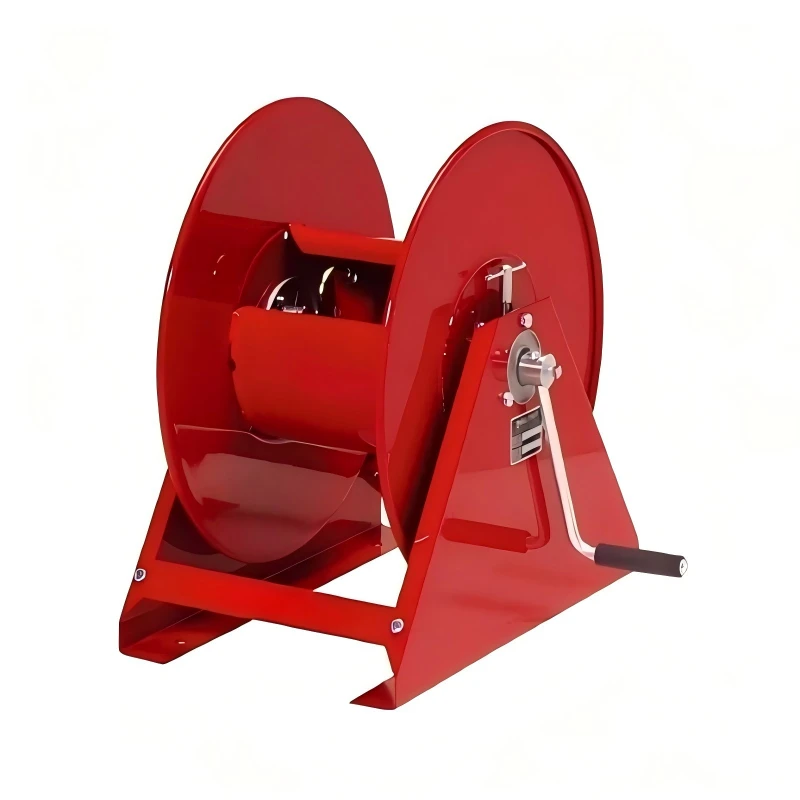
The defining feature of this reel is its manually operated crank positioned on the side of the reel assembly.
Turning the crank rotates the drum and moves the hose onto or away from the reel. The operator therefore determines how much hose is deployed and when the hose is returned.
This operating method is useful when precise hose positioning is more important than automatic retraction.
The crank-operated arrangement allows the user to:
- Release hose gradually
- Stop hose deployment at the required position
- Wind the hose back manually
- Control the winding speed
- Keep the hose stored when not required
- Avoid spring-driven retraction
The operator remains in direct control of the reel throughout the winding process.
Manual Winding Without Spring Tension
Unlike a spring-driven reel, the Side Mounted Hand Crank Reel does not depend on stored spring energy to return the hose.
The drum remains in its current position until the operator turns the crank.
This difference can be useful for applications where:
- The hose must remain extended for long periods
- Retraction should not occur automatically
- The operator needs gradual hose movement
- Different hose lengths are used during different tasks
- The hose is relatively heavy
- Controlled storage is preferred over automatic return
Manual operation also eliminates the need to match spring tension to the weight of the hose.
Instead, the reel's mechanical capacity and crank transmission are selected according to the hose assembly and operating conditions.
Side-Mount Configuration Saves Working Space
The crank is positioned on the side of the reel rather than directly across the front of the drum.
This arrangement can be advantageous where installation space is limited or where the reel needs to be mounted close to a machine, wall, frame, or service structure.
The side-mounted layout separates two functions:
Stores the hose.
Provides the operator interface for manual winding.
The result is a compact operating arrangement in which the user can access the crank from the side without having to reach across the hose storage drum.
The actual clearance required should be determined from the reel dimensions and crank rotation path.
Controlled Hose Positioning
Manual operation provides more control over the hose position than an automatic return mechanism.
For example, an operator may need only part of the hose length during one maintenance task and a substantially longer section during another.
The crank allows the hose to be positioned according to the immediate requirement.
A typical operation is:
The hose does not need to return automatically when the operator releases it.
This can be useful for service operations in which the hose remains connected to equipment for an extended period.
Mechanical Drive System
The hand crank transfers manual input to the reel drum through the reel's mechanical drive assembly.
The crank provides leverage, allowing the operator to rotate the drum without directly grasping the hose.
The drive system normally includes:
- Hand crank
- Drive shaft
- Drum
- Support structure
- Hose connection
- Mounting components
The exact transmission arrangement depends on the reel design.
For heavier hose assemblies, the mechanical advantage provided by the crank becomes particularly important because direct manual winding can require greater physical effort.
Suitable for Long-Term Hose Deployment
Some hose applications do not require automatic retraction.
A hose may need to remain extended while equipment is operating, while a service connection is being maintained, or while fluid is being transferred.
With a hand crank reel, the operator can leave the hose at the required length without the spring force attempting to pull it back.
This makes the configuration suitable for applications involving:
- Extended hose deployment
- Stationary service connections
- Equipment maintenance
- Fluid transfer
- Industrial utility lines
- Manual hose positioning
The reel functions primarily as a storage and positioning device rather than an automatic hose-return system.
Applications in Industrial Workshops
The reel can be installed at fixed service points where hoses are used repeatedly but do not require automatic retraction.
In a workshop, the hose can be unwound to the required area and manually returned after the operation.
Potential applications include:
A suitable hose assembly can be used for hydraulic fluid service where the hose must be manually positioned around machinery.
The reel can organize lubricant delivery hoses around maintenance areas.
Industrial water hoses can be stored and manually deployed for cleaning or equipment service when compatible components are selected.
For compatible compressed-air hose systems, the reel can provide organized manual storage.
The reel and hose must always be specified according to the pressure, medium, and environmental requirements of the actual application.

Hose Storage and Drum Capacity
The reel drum determines how much hose can be stored.
Hose capacity depends on several physical dimensions, including:
- Hose outside diameter
- Hose length
- Drum width
- Drum diameter
- Number of winding layers
A larger hose requires more storage space per winding layer. Increasing hose length also increases the number of layers accumulated on the drum.
The hose should be wound evenly to avoid unnecessary stacking at one side of the reel.
Where the hose has a defined minimum bend radius, the drum diameter should also be selected accordingly.
Manual Reel for Heavy or Stiff Hoses
Manual crank operation can be particularly practical for hoses that are difficult to handle by hand.
Large-diameter industrial hoses may have considerable weight and stiffness. Carrying or manually coiling such hoses can be inconvenient, especially after a long working period.
The crank provides mechanical assistance by transferring the operator's input through the reel drive system.
Instead of lifting and coiling the entire hose assembly manually, the operator can rotate the crank to wind the hose onto the drum.
The required crank effort depends on the hose weight, winding diameter, hose condition, and mechanical design of the reel.
Mounting Options
The reel is designed around a side-mounted operating configuration and can be incorporated into different industrial structures.
Possible installation locations include:
- Workshop walls
- Equipment frames
- Service stations
- Industrial platforms
- Maintenance vehicles
- Machinery structures
- Custom support frames
The mounting surface should be strong enough to support the complete reel and hose assembly.
The crank side should also remain accessible. Before installation, sufficient space should be left for full crank rotation and operator access.
Hose Exit Direction
The position and direction from which the hose leaves the drum affect the usability of the reel.
The installation should allow the hose to travel toward the working area without unnecessary sharp bends or contact with obstacles.
When planning the installation, consider:
A suitable arrangement minimizes interference with machinery, walkways, and other service equipment.
For mobile installations, hose routing should also account for movement of the vehicle or equipment.
Industrial Media Compatibility
The reel can be configured for different industrial hose applications, provided that the hose and fluid-path components are compatible with the working medium.
Potential media include:
- Hydraulic oil
- Lubricating oil
- Water
- Compressed air
- Cleaning fluids
- Other compatible industrial fluids
Compatibility should be checked for the complete assembly, including the hose, fittings, swivel, seals, and other fluid-contact components.
Pressure and temperature requirements should also be considered before selecting the configuration.
Choosing a Hand Crank Reel
The main selection parameters are different from those of an automatic spring reel.
| Parameter | Selection Consideration |
|---|---|
| Operating Method | Manual hand crank |
| Hose Length | Required working distance and storage capacity |
| Hose I.D. | Required flow capacity |
| Hose O.D. | Determines drum capacity |
| Hose Weight | Influences crank effort and reel structure |
| Working Pressure | Based on hose and fluid-path components |
| Medium | Determines hose and seal compatibility |
| Minimum Bend Radius | Determines suitable drum diameter |
| Crank Position | Must remain accessible |
| Mounting Location | Wall / equipment / vehicle / custom frame |
| Hose Exit Direction | Based on working area |
| Environment | Indoor / outdoor / wet / dusty / corrosive |
A hand crank reel should be selected according to how the hose will actually be used, not simply according to its physical dimensions.
Manual Control for Maintenance Operations
Maintenance work is often irregular. One task may require a short hose reach, while another may require the hose to travel around the opposite side of the equipment.
A manually operated reel accommodates this variation without forcing the hose to retract whenever it is released.
The operator can:
- Rotate the crank to release the required hose.
- Position the hose at the equipment.
- Keep the hose extended throughout the operation.
- Return to the reel after completing the task.
- Rotate the crank in the opposite direction.
- Store the hose on the drum.
This makes the reel suitable for maintenance environments where hose position changes from one job to another.
Maintenance of the Hand Crank Reel
Because the reel is manually operated, inspection should focus on the mechanical drive and hose storage system.
Check periodically for:
- Excessive crank resistance
- Loose mounting hardware
- Drum deformation
- Irregular hose winding
- Damaged hose
- Worn drive components
- Fluid leakage at connections
- Corrosion
- Abnormal movement
The hose should be kept properly wound on the drum rather than allowed to form uncontrolled loops.
If the reel becomes difficult to rotate, the cause should be identified before continued operation.
Technical Specifications
| Parameter | Specification |
|---|---|
| Product Type | Side Mounted Hand Crank Reel |
| Operating Method | Manual |
| Drive | Hand crank |
| Hose Length | According to selected model |
| Hose I.D. | According to selected model |
| Hose O.D. | According to selected model |
| Maximum Pressure | According to selected model |
| Working Medium | According to hose compatibility |
| Inlet Connection | According to selected model |
| Outlet Connection | According to selected model |
| Drum Capacity | According to selected model |
| Mounting | Wall / Equipment / Vehicle / Custom |
| Reel Material | According to selected model |
| Hose Material | According to application |
| Customization | Available |
Side Mounted Hand Crank Reel for OEM Projects
For machinery manufacturers and equipment integrators, the reel can be incorporated into the machine layout during the design stage.
The side-mounted operating position can be arranged around the operator's access point, while the drum can be positioned close to the hose supply or service connection.
OEM configuration may cover:
- Drum dimensions
- Hose capacity
- Hose length
- Hose diameter
- Crank position
- Mounting bracket
- Connection type
- Reel material
- Hose specification
- Surface treatment
- Identification and labeling
The machine layout, hose routing, and operator working position should be considered together when defining the final reel configuration.
Why Choose a Side Mounted Hand Crank Reel?
The operator determines when and how far the hose is wound or unwound.
The hose remains in its selected position until the crank is operated.
The crank provides mechanical assistance for winding hoses that may be difficult to coil manually.
The side-mounted crank provides access without requiring the operator to reach across the drum.
The drum provides a dedicated storage position for unused hose.
The reel can be configured for different hose dimensions, media, mounting positions, and working environments.
FAQ
What is a side mounted hand crank reel?
It is a manually operated hose reel with a crank positioned on the side of the reel. Turning the crank rotates the drum to deploy or store the hose.
Does a hand crank reel automatically retract the hose?
No. Unlike a spring-driven reel, the hose remains in its current position until the operator turns the crank.
Why use a hand crank instead of a spring mechanism?
Manual operation provides direct control and is useful when the hose needs to remain extended or when controlled winding is preferred.
Is a hand crank reel suitable for heavy hoses?
Yes. The crank can provide mechanical assistance when winding heavier or stiffer hoses, provided that the reel is correctly sized for the hose assembly.
Where can the reel be installed?
It can be installed on suitable walls, equipment frames, service stations, vehicles, or custom support structures.
Can it be used for hydraulic hose?
Yes, when the hose reel and complete hose assembly are properly selected for hydraulic fluid, working pressure, hose dimensions, temperature, and connection requirements.
Can the side-mounted hand crank reel be customized?
Yes. Drum capacity, hose dimensions, crank configuration, mounting structure, connections, materials, and other specifications can be configured according to the application.
Hot Tags: side mounted hand crank reel, China, manufacturers, suppliers, factory, custom, price, for sale