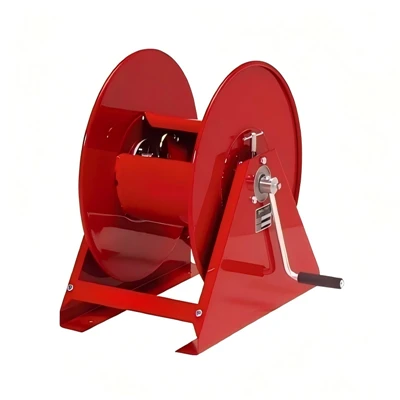
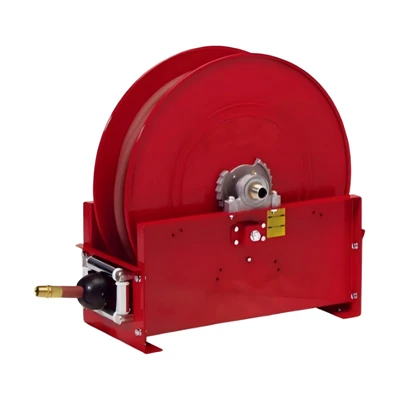
Front Mounted Hand Crank Reel - Application & Specification Guide
1. The Reel as a Front Service Interface
In many industrial installations, the position of the hose connection is determined by the machine rather than by the hose reel itself.
Operators may approach a machine from one designated direction. Control panels, valves, gauges, switches, and service connections are often arranged on the same accessible face.
A front-mounted reel can be incorporated into this arrangement.
Instead of walking around the equipment to operate the reel, the operator can access the crank from the same general direction used to service the machine.
This makes the reel particularly suitable for:
- Equipment front panels
- Maintenance cabinets
- Service skids
- Machinery frames
- Workshop stations
- Utility modules
- Mobile service equipment
The reel therefore becomes part of the service layout rather than simply a storage component.
2. Organized Operator Working Zone
A hose can become difficult to manage when its storage location and service location are separated.
A front-mounted reel establishes a defined point where the hose begins its working route.
The operator can identify:
Storage Position → Hose Release Point → Service Area
This arrangement helps establish a predictable working zone around the equipment.
For maintenance personnel, the benefit is not simply that the hose is stored neatly. The hose originates from a known position, which makes its routing easier to understand and repeat between service operations.
This is particularly useful on machines with fixed maintenance procedures.
3. Designed for Equipment Face-Mounting
The front mounting concept allows the reel to be incorporated into fabricated equipment structures.
A manufacturer can reserve a mounting area on the front face of the machine and position the reel according to the available panel dimensions.
The mounting interface can be considered together with:
- Panel thickness
- Structural members
- Hose inlet position
- Hose outlet location
- Crank clearance
- Adjacent controls
- Maintenance access
- Operator standing position
This approach is useful when the available installation area is determined during equipment design.
The reel can be integrated into the machine envelope rather than occupying additional floor space.

4. Front Access for Repetitive Service Work
Some industrial hose applications are performed at the same machine repeatedly.
For example, maintenance personnel may service the same lubrication point, wash the same equipment section, or connect the same utility hose at regular intervals.
In these cases, a front-mounted reel provides a consistent starting point.
The operator approaches the designated service face, accesses the crank, obtains the required hose length, and carries out the task.
Afterward, the hose can be returned to its storage position.
The repeatability of the access point can be useful in workshops where several machines follow similar maintenance procedures.
5. Suitable for Panel and Cabinet Arrangements
The front-facing configuration can be particularly useful where equipment has a defined enclosure or cabinet architecture.
A reel can be positioned alongside other service elements such as:
- Hose connections
- Valves
- Pressure gauges
- Control switches
- Utility outlets
- Lubrication points
- Inspection openings
This creates a consolidated service area.
For custom equipment, the reel position can be established during the layout stage so that the crank, hose outlet, and connection points do not conflict with other components.
6. Hose Routing as Part of Machine Layout
The hose route should be considered from the reel to the actual point of use.
A front-mounted arrangement allows the hose outlet to be planned around the machine's working face.
For example, the hose may need to travel:
Forward → Downward
for a floor-level maintenance task, or:
Forward → Sideward
for equipment positioned beside the service station.
Another installation may require:
Forward → Upward
for overhead cleaning or servicing.
The selected hose length should provide the required reach without creating excessive unused loops.
The hose path should remain separated from moving components and areas where mechanical damage could occur.
7. A Practical Choice for Compact Equipment
Equipment manufacturers frequently need to fit multiple functions into a restricted footprint.
A front-mounted reel can use the vertical or front-facing surface of the equipment rather than requiring an additional floor-mounted structure.
This can be advantageous for:
- Compact machinery
- Service cabinets
- Skid-mounted systems
- Workshop equipment
- Mobile maintenance units
- Enclosed utility systems
The available front surface can be used as the operating zone while the reel occupies the corresponding storage area.
The actual dimensions of the reel, crank, hose and mounting structure should be checked against the equipment envelope.
8. Manual Hose Positioning for Different Tasks
The same machine may require different hose lengths for different service procedures.
A short hose extension may be sufficient for one maintenance point, while another task may require access to a component located farther away.
The hand crank allows the operator to decide how much hose is released.
This is different from designing the system around one predetermined working length.
The operator can adapt hose deployment to:
- Equipment position
- Maintenance location
- Cleaning area
- Service distance
- Operator position
The hose can then be returned to the reel after the operation.
9. Application in Equipment Maintenance
Front-mounted reels can be incorporated into maintenance-oriented equipment where hoses are regularly required at the front service area.
Examples include:
- Machinery Service Equipment: The reel can provide access to hoses used during equipment inspection and maintenance.
- Workshop Service Stations: The reel can be positioned at a designated work face where technicians routinely handle hoses.
- Industrial Cleaning Equipment: A suitable hose assembly can be stored behind the front operating area and extended toward the cleaning zone.
- Lubrication Equipment: The reel can organize a lubrication hose around a fixed maintenance position.
- Mobile Service Units: The front or accessible face of a service vehicle or maintenance unit can be used as the operating side of the reel.
10. Front-Mounted Configuration for Service Vehicles
On mobile service equipment, space must often be divided between tanks, pumps, tools, hose assemblies, and operator access.
A front-mounted reel can provide a defined hose access point without requiring the operator to enter the equipment compartment every time the hose is needed.
The reel can be positioned on an accessible outer face while the supply connection remains behind or within the equipment structure.
This arrangement can separate:
Operator Area - from - Fluid Supply Area
The hose remains accessible to the operator while the fixed supply components can be protected within the equipment layout.
11. Hose Storage Without Floor-Level Coiling
Loose industrial hose on the floor can interfere with movement around equipment.
A reel provides an elevated storage location and establishes a defined route between storage and operation.
This can be useful in workshops where the available floor area is already occupied by machinery, vehicles, tools, and maintenance equipment.
Keeping the hose on the reel when not in use can also reduce uncontrolled loops around the work area.
The reel should be positioned at a height and location that allow the hose to move freely without creating excessive bending or abrasion.
12. Front Crank Accessibility
The hand crank should remain accessible throughout normal operation.
When planning the front installation, consider the distance between the crank and:
- Equipment panels
- Doors
- Handles
- Control devices
- Structural members
- Adjacent reels
- Operator pathways
The crank should have sufficient clearance for rotation.
If several reels are installed together, each crank should have a clearly defined operating area so that one reel does not interfere with another.
13. Industrial Hose Applications
The reel can be used with different hose assemblies when the complete configuration is correctly specified.
| Application | Typical Purpose |
|---|---|
| Hydraulic Hose | Equipment maintenance and hydraulic service |
| Lubrication Hose | Oil or lubricant delivery |
| Water Hose | Industrial cleaning and utility supply |
| Air Hose | Pneumatic service |
| Cleaning Hose | Equipment washing and maintenance |
| Utility Hose | General industrial fluid or gas service |
The working medium, pressure, temperature, hose construction, fittings, seals, and connections should all be evaluated for the intended application.

14. Configuration According to Equipment Geometry
For a standard standalone hose reel, the surrounding equipment may not be a major design constraint.
For a front-mounted reel, it becomes an important part of the specification.
The available installation area can be described by:
Mounting Width × Mounting Height × Available Depth
The equipment designer should also provide the intended hose exit direction and the operator's approach position.
These dimensions can be used to determine whether the selected reel can be incorporated without interfering with existing machine components.
15. Front Mounted Hand Crank Reel Specifications
| Item | Configuration |
|---|---|
| Reel Type | Front Mounted Hand Crank Reel |
| Operating Mode | Manual |
| Crank Access | Front-facing |
| Hose Length | Model dependent |
| Hose I.D. | Model dependent |
| Hose O.D. | Model dependent |
| Hose Capacity | Model dependent |
| Working Pressure | Model dependent |
| Medium | Application dependent |
| Inlet | Model dependent |
| Outlet | Model dependent |
| Mounting Position | Front panel / Frame / Wall / Equipment |
| Hose Exit | Application dependent |
| Reel Material | Model dependent |
| Surface Finish | Application dependent |
| Custom Design | Available |
16. Integration with Custom Machinery
The front-mounted arrangement is well suited to equipment projects where hose management needs to be included in the original machine design.
A manufacturer can reserve a dedicated reel position and determine the hose route before the equipment is fabricated.
Important design information includes:
- Equipment Front Width: Determines available mounting area.
- Available Depth: Determines whether the reel body can fit within the machine envelope.
- Operator Position: Determines practical crank access.
- Hose Destination: Determines outlet orientation and required hose length.
- Supply Connection: Determines how the fixed line reaches the reel.
- Service Clearance: Determines whether inspection and replacement can be performed.
This approach avoids treating the hose reel as an afterthought.
17. Material Selection
The reel construction should correspond to the environment in which the equipment operates.
General workshop applications may prioritize mechanical strength and surface protection.
Outdoor or wet environments may require greater attention to corrosion resistance.
Where the reel is exposed to oils, lubricants, cleaning agents, or other industrial substances, the material and surface treatment should be evaluated together with the operating medium.
For specialized environments, stainless steel or other corrosion-resistant construction may be considered when required by the application.
18. Maintenance Access
A front-mounted product should remain serviceable after installation.
The installation should allow technicians to reach the relevant components without dismantling unrelated equipment.
Inspection areas may include:
- Hose condition
- Crank mechanism
- Drum
- Mounting points
- Hose connections
- Fluid leakage
- Surface corrosion
- Hose winding
For equipment manufacturers, maintenance access should be considered during the initial layout instead of being added after installation.
19. Front Mounted Hand Crank Reel for OEM Equipment
For OEM applications, the reel can be developed around the machine's physical and functional requirements.
The manufacturer can provide:
- Equipment drawings
- Mounting dimensions
- Hose specifications
- Required hose length
- Working pressure
- Working medium
- Hose destination
- Front-panel layout
- Installation environment
The reel configuration can then be coordinated with the equipment structure and service workflow.
This is particularly useful for machinery that will be produced in multiple units, where consistent reel positioning and hose routing are required across the equipment series.
20. Why Use a Front Mounted Hand Crank Reel?
- Front-facing service access: The operator works from the same direction as the equipment's primary service area.
- Defined hose starting point: The hose originates from a fixed, identifiable location.
- Efficient equipment integration: The reel can occupy part of the machine's front structure rather than requiring a separate floor installation.
- Manual hose positioning: The operator controls the deployed hose length according to each task.
- Suitable for compact layouts: The reel can make use of available front-facing equipment surfaces.
- Adaptable for OEM equipment: The mounting arrangement can be developed together with the machine layout.
21. Front Mounted Hand Crank Reel Selection Checklist
Before selecting the reel, confirm:
- Front mounting dimensions
- Available installation depth
- Required hose length
- Hose outside diameter
- Hose inside diameter
- Hose weight
- Working pressure
- Working medium
- Minimum bend radius
- Hose outlet direction
- Operator position
- Crank clearance
- Supply connection
- Environmental conditions
- Required maintenance access
These details provide the basis for matching the reel to the actual equipment rather than selecting it solely by nominal hose capacity.
22. Front Mounted Hand Crank Reel for Industrial Hose Management
The Front Mounted Hand Crank Reel is a practical option for equipment layouts where hose access, storage, and operator position need to be organized around a front-facing service area.
Its value lies in the relationship between the reel and the equipment: the hose is stored at a designated location, the crank is accessible from the working face, and the hose route can be planned around the machine.
For custom equipment, the reel can be specified according to the available mounting envelope, hose requirements, operating conditions, and service workflow.
Hot Tags: font mounted hand crank reel, China, manufacturers, suppliers, factory, custom, price, for sale