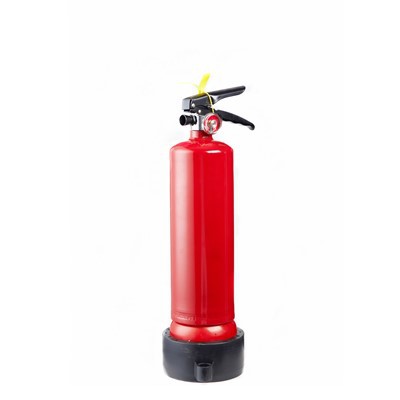
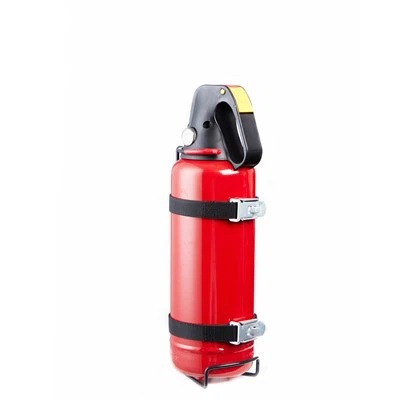
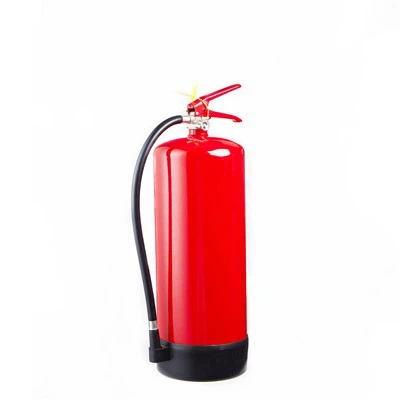
Dry powder fire extinguisher is a kind of fire extinguisher. According to the type of dry powder fire extinguishing agent, it is divided into: ordinary dry powder fire extinguisher and ultra-fine dry powder fire extinguisher. According to the movement mode, it is divided into three types: portable, backpack and cart. The fire extinguisher is equipped with dry powder fire extinguishing agents such as ammonium phosphate salt. This dry powder fire extinguishing agent is easy to flow and dry. It is composed of inorganic salts and crushed and dried additives, which can effectively fight the initial fire.
The dry powder fire extinguisher uses carbon dioxide gas or nitrogen gas as power to spray out the dry powder in the cylinder, which can extinguish general fires and extinguish fires caused by the burning of oil and gas.
Ordinary dry powder fire extinguisher
Dry powder fire extinguisher
Common dry powder fire extinguishing agents are mainly composed of active fire extinguishing components, hydrophobic components, and inert fillers. The hydrophobic components mainly include silicone oil and hydrophobic white carbon black. There are many types of inert fillers, which mainly prevent vibration and agglomeration, improve the movement performance of dry powder, and catalyze dry powder. Silicone oil polymerization and improving compatibility with foam fire extinguishing agents. This kind of ordinary dry powder fire extinguishing agent has been widely used at home and abroad.
The fire extinguishing component is the core of the dry powder fire extinguishing agent. The main substances that can play a fire extinguishing effect are: K2CO3, KHCO3, NaCl, KCl, (NH4)2SO4, NH4HSO4, NaHCO3, K4Fe(CN)6·3H2O, Na2CO3, etc., currently domestic The products that have been produced are: ammonium phosphate, sodium bicarbonate, sodium chloride, potassium chloride dry powder fire extinguishing agent. Each type of fire extinguishing particle has an upper critical particle size. Particles smaller than the critical particle size are all used to extinguish the fire. Particles larger than the critical particle size have a sharply reduced fire extinguishing efficiency, but their momentum is large, and the air generates aerodynamic pull on small particles. Forcing small particles to follow closely and rush to the center of the flame instead of being blown away by the hot air flow before reaching the flame, reducing the efficiency of fire fighting. The particle size of commonly used dry powder fire extinguishing agents is between 10 and 75 μm. This kind of particles has poor dispersion and relatively small specific surface area.
Therefore, the total specific surface area of the quantitative dry powder is small, the mass of individual particles is large, the sedimentation speed is faster, and the decomposition speed is slow when heated, resulting in a small ability to capture free radicals, so the fire extinguishing ability is limited, which limits it to a certain extent. Use range of dry powder fire extinguishing agent. The particle size of dry powder fire extinguishing agent is directly related to its fire extinguishing efficiency. The larger the critical particle size of the fire extinguishing component, the better the fire extinguishing effect. Therefore, preparing ultrafine fire extinguishing powder that can be uniformly dispersed and suspended in the fire space, ensuring the activity of the fire extinguishing component particles, and reducing the amount of fire extinguishing agent used per unit space is a very effective means to improve the fire extinguishing efficiency of the dry powder fire extinguishing agent.
a. Combustion characteristics: Combustion is a kind of violent oxidation reaction involving oxidant, and the combustion process is a chain reaction. In the presence of high temperature and oxygen, the combustible molecules are activated to generate free radicals. The free radicals have high energy and are extremely active. Once they are generated, they immediately initiate the next reaction and generate more free radicals. These many free radicals with high energy are again Initiate more free radicals. In this way, relying on the continuous transmission of chain reactions by free radicals, the molecules of combustible substances are gradually cracked to maintain the continuous combustion.
b. Fire extinguishing characteristics: suffocation, cooling and chemical inhibition of flaming combustion are concentrated expressions of the effectiveness of dry powder fire extinguishing. Among them, chemical inhibition is the basic principle of fire extinguishing and plays the main role of fire extinguishing. The fire extinguishing component in the dry powder fire extinguishing agent is the inactive substance of the combustion reaction. When it enters the flame in the combustion zone, the free radicals generated by decomposition react with the free radicals such as H and OH generated in the flame combustion reaction to capture and terminate the combustion. The free radicals produced by the reaction reduce the rate of the combustion reaction. When the concentration of dry powder in the flame is high enough, the contact area with the flame is large enough, and the rate of radical suspension is greater than the rate of combustion reaction generation, the chain combustion reaction is terminated and the flame is extinguished. The dry powder fire extinguishing agent decomposes by endothermic in the combustion flame. Because each step of the decomposition reaction is an endothermic reaction, it has a better cooling effect. In addition, ammonium dihydrogen phosphate decomposes at high temperatures, forming a layer of glassy film residue covering the surface of the solid material to prevent the combustion from proceeding and to prevent re-ignition.
Superfine dry powder fire extinguishing agent
Due to its large specific surface area and high activity, ultra-fine fire extinguishing particles can be suspended in the air for several minutes to form a relatively stable aerosol. Therefore, not only is the fire extinguishing efficiency high, but the use method is completely different from the general traditional dry powder fire extinguishing agent, which is similar Halogen flooding type fire extinguishing. For example, the fire-extinguishing concentration of KHCO3 aerosol is only 2.0% of 1301 halogenated alkanes, but the fire-extinguishing efficiency is equivalent to 50 times that, and the deposits after fire-extinguishing are not obvious, which causes little pollution to the fire site. KHCO3, NaCl, KCl, K2SO4, NH4H2PO4, NaHCO3 can all be used to prepare aerosol fire extinguishing agents. The particle size of aerosol fire extinguishing agent is required to be less than <5μm, preferably less than 0.5μm. Aerosol has now become an independent new research field.
The fire extinguishing efficiency of a unit fire extinguishing agent is closely related to the particle size of the fire extinguishing agent. The larger the critical particle size of the fire extinguishing component and the greater the fraction of extinguishing particles smaller than the critical particle size, the better the fire extinguishing effect. The minimum detectable particle size in the national standard is 40μm, and the specific distribution is not specified if it is smaller than this value. In fact, the critical particle size of all types of fire extinguishing particles is mostly smaller than this value. For example: K2SO4 is 16μm, NaHCO3, NaCl is 20μm, NH4H2SO4 is 30μm. Therefore, if the particle size of the fire extinguishing agent is reduced to the critical particle size, the fire extinguishing efficiency will be greatly improved. For example, using K2SO4 with a particle size of less than 20μm to prepare ultra-fine dry powder fire extinguishing agent, when its dosage is only 20%, it is found that its fire extinguishing efficiency is 121% higher than that of ordinary K2SO4 fire extinguishing agent; the fire extinguishing efficiency of NaHCO3 fire extinguishing agent with particle size less than 43μm is ordinary 221% of the type, the fire extinguishing efficiency is doubled. When the particle size of the ultrafine dry powder fire extinguishing agent is smaller than the critical particle size, all the fire extinguishing agent particles play a role in fire extinguishing, and the efficiency of dry powder fire extinguishing is greatly improved, and the amount is significantly reduced. When the particle size of the fire extinguishing agent is reduced to 5 μm, or even 0.5 μm, the fire extinguishing efficiency rises sharply. The fire extinguishing efficiency is dozens of times that of the conventional fire extinguishing agent, and the amount is only a few percent of it. This is mainly because: the ratio of the total surface area to the volume of the ultra-fine powder is large, the activity is high, it forms a relatively stable aerosol that is uniformly dispersed and suspended in the air, has a fast thermal decomposition speed, and has a strong ability to trap free radicals, so the fire extinguishing efficiency is greatly improved . [1]
Documentary records: British KIDD company has developed a superfine potassium bicarbonate powder fire extinguishing agent with a particle size of <5μm. The total submerged fire extinguishing experiment shows that the fire extinguishing efficiency is 10 times that of general fire extinguishing agents. Zhang Wei and others prepared ammonium phosphate superfine dry powder fire extinguishing agent by aqueous phase synthesis method, using ammonium dihydrogen phosphate as the main material, adding talc, mica powder, activated clay, silicone oil, white carbon black, sodium silicate and other auxiliary materials. Successfully prepared ultrafine ammonium phosphate dry powder fire extinguishing agent with a particle size of 100~500nm. The dry powder fire extinguishing agent has low price, good fire extinguishing effect, and can produce greater economic and social benefits.