Recently, a fire extinguisher bracket in a shopping mall was not closed correctly, causing the fire extinguisher to accidentally fall due to the vibration of daily people walking around, almost causing injuries. This incident has aroused the industry's high attention to the correct use and closing operation of fire extinguisher brackets. Correctly closing the fire extinguisher bracket is not only related to the stability of the equipment, but also directly affects whether the fire extinguisher can be quickly and safely used when a fire occurs. It is an important link that cannot be ignored in fire safety management.
Content
1.Common fire extinguisher bracket types and closing methods
1.1Wall-mounted fire extinguisher bracket
1.2Car-mounted fire extinguisher bracket
1.3Floor-mounted fire extinguisher bracket
2.Safety regulations and precautions for closing the fire extinguisher bracket
3.Experts call for strengthening training and daily management

Common fire extinguisher bracket types and closing methods
Wall-mounted fire extinguisher bracket
Wall-mounted fire extinguisher bracket is the most common type in public places. Its design principle is mainly to fix the fire extinguisher by hooks or clips. Taking a well-known brand of wall-mounted bracket as an example, when closing, the bottom of the fire extinguisher needs to be placed steadily on the bracket's support hook to ensure that the bottom fits completely. Then, wrap the elastic retractable belt or metal hoop around the fire extinguisher body, and pay attention to adjust it to the appropriate tightness. Too loose may cause the fire extinguisher to shake or even fall, and too tight may cause damage to the fire extinguisher bottle. Finally, fasten the lock. Some wall-mounted brackets with push-type locks only need to put the fire extinguisher in the corresponding position when closing, and press the lock to achieve automatic locking. The operation is simple, but it is necessary to confirm that the lock is fully engaged.
Car-mounted fire extinguisher bracket
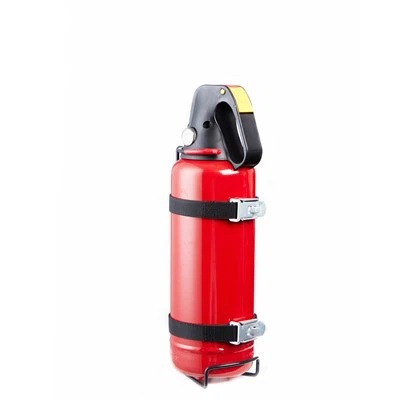
Due to the special use environment of the vehicle, the closing method of the car-mounted fire extinguisher bracket also has unique requirements. Taking a common car as an example, the car-mounted fire extinguisher bracket mostly adopts elastic straps or slot design. When closing, first place the fire extinguisher steadily into the bracket slot. If it is an elastic strap, pass the strap through the fixing hole and tighten it so that the strap is close to the surface of the fire extinguisher; if it is a slot type, make sure that the bottom of the fire extinguisher is completely embedded in the bottom of the slot, and the upper edge fits tightly with both sides of the slot to prevent the fire extinguisher from shifting due to bumps during driving. For large trucks, buses, etc., the vehicle-mounted fire extinguisher bracket usually has a stronger load-bearing capacity and may be fixed by a rotating or snap-on type. For example, when closing a special bracket for a truck, you need to first place the fire extinguisher on the bracket base, rotate the knob on the top of the bracket, and press and fix the fire extinguisher through the internal threaded structure. After the operation is completed, you need to manually shake the fire extinguisher to check the fixing effect.
Floor-mounted fire extinguisher bracket
Floor-mounted fire extinguisher brackets are often used in large places such as factory workshops and warehouses, and are mostly used to fix cart-type fire extinguishers. This type of bracket is usually equipped with movable guardrails or adjustable buckles. When closing, first push the cart-type fire extinguisher into the bracket, adjust it to the appropriate position, then lower the movable guardrail, make sure the locks at both ends of the guardrail are completely locked to prevent the fire extinguisher from moving forward, backward, left and right; for brackets with adjustable buckles, adjust the buckle position according to the size of the fire extinguisher, and fasten the buckle on the fire extinguisher cart to ensure that the cart-type fire extinguisher will not fall off the bracket during transportation or use.
Safety regulations and precautions for closing the fire extinguisher bracket
When closing the fire extinguisher bracket, safety regulations must be strictly followed. First, ensure that the bracket is firmly installed. Before installation, check whether the wall, vehicle body and other installation parts are stable. If the wall is loose or the vehicle body surface is uneven, it is necessary to repair or change the installation position in time. Secondly, avoid collision with the fire extinguisher during the closing process. Any violent collision may affect the sealing performance or internal pressure of the fire extinguisher, causing it to fail. In addition, it is crucial to regularly check the closing status of the bracket. It is recommended to conduct a visual inspection once a week to check whether the lock is loose, whether the strap is aging, whether the slot is deformed, etc., and conduct a functional test once a month, such as trying to slightly shake the fixed fire extinguisher to check the fixing effect.
Experts call for strengthening training and daily management
"Many fire cases show that it is common for fire extinguishers to be unable to be used in time due to improper closing of fire extinguisher brackets." A fire safety expert said in an interview, "Enterprises and relevant units should strengthen employee training to ensure that everyone can master the closing methods of different types of fire extinguisher brackets, and incorporate the inspection and maintenance of fire extinguisher brackets into the daily safety management system." At the same time, experts suggest introducing intelligent management methods, such as installing sensors on the bracket to monitor the fixing status of the fire extinguisher in real time. Once looseness or displacement is found, an alarm will be issued immediately to improve the timeliness and effectiveness of fire safety management.
Correctly closing the fire extinguisher bracket is the basic operation to build a solid fire safety line of defense. Whether it is the manager of a public place or an ordinary user, they should pay attention to this link, strictly follow the standard operation, and regularly check and maintain the fire extinguisher, so that the fire extinguisher can truly become a powerful weapon to protect the safety of life and property at critical moments.