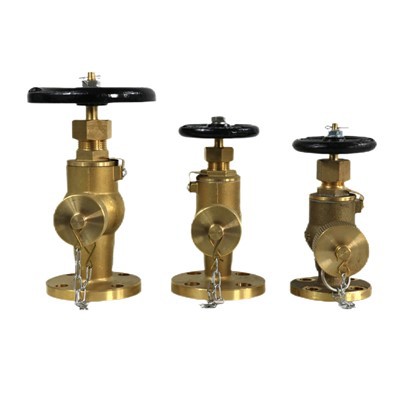
Oblique landing valves are specialized components used in firefighting systems. They are typically installed at specific locations within buildings or structures to provide firefighters with access to water for firefighting purposes. These valves are angled (oblique) in design, which facilitates easier connection of firefighting hoses during emergencies. They serve as an interface between the building's internal plumbing system and the external firefighting hose lines. When not in use, oblique landing valves remain closed to maintain the integrity of the building's water supply system. They are robustly constructed to withstand high water pressures and adverse environmental conditions, ensuring reliable performance during critical situations.
Oblique Screw Landing Vavles are manufactured to BS5041.The landing vavles are classified under low pressure and are suitable for use at nominal inlet pressure up to 16 bar.
Body:Copper Alloy or LG2 as per requipment.
Handwheel:Grey Cast Iron
Inlet:2.5''BSP male thread or BS4504 flanged
Outlet:2.5''BS336 Female instantaneous coupling with plastic cap and chain.
Working Pressure:16 bar
Test Pressure:24 bar
Nominal Size:DN65 or 2-1/2''

Advantage Of Oblique Type Landing Valves
Ease of Access
Due to their angled design, oblique landing valves provide easier access for firefighters to connect hoses during emergencies, compared to vertical or horizontal valves.
Quick Deployment
Firefighters can quickly deploy hoses and access water, reducing response times and potentially minimizing fire damage.
Durability
These valves are built to withstand high water pressures and harsh environmental conditions, ensuring reliable operation when needed most.
Standardization
They adhere to industry standards and regulations, ensuring compatibility with firefighting equipment and procedures, which enhances operational efficiency.
Products

Wet Riser Landing Valve

Oblique Hydrant Valve

Oblique Landing Valve
Body:Copper Alloy or LG2 as per requirement
Handwheel:Grey Cast Iron

Fire Hydrant Landing Valves
Body:Copper Alloy or LG2 as per requirement
Handwheel:Grey Cast Iron
Components Of Oblique type wet landing valve
Body
The main structure of the valve, typically made of durable materials like brass or bronze, designed to withstand high pressure and harsh environmental conditions.
Handwheel
Used to manually open or close the valve. Turning the handwheel controls the movement of the valve stem and, consequently, the flow of water.
Stem
A threaded rod connected to the handwheel. When the handwheel is turned, the stem moves up or down to open or close the valve.
Bonnet
The component that covers the stem and the internal mechanism of the valve. It provides a seal to prevent leaks and protects the internal parts.
Seat
The part of the valve body where the disc rests when the valve is closed, ensuring a tight seal to prevent water from flowing.
Disc
Attached to the end of the stem, the disc moves up and down to open or close the valve by making or breaking the seal with the seat.
Inlet and Outlet Ports
These are the openings through which water enters and exits the valve. The inlet is connected to the water supply, and the outlet connects to the firefighting hose.
Pressure Regulating Mechanism (for OPRV)
In pressure-regulating oblique landing valves, this mechanism adjusts the water pressure to a preset level, ensuring consistent output.
Material Of Oblique Landing Valve
Brass
Properties: Corrosion-resistant, durable, and capable of withstanding high pressures and temperatures.
Application: Often used for both the body and internal components due to its reliability and longevity.
Bronze
Properties: Similar to brass, bronze is highly resistant to corrosion and offers excellent strength and durability.
Application: Commonly used for the valve body and moving parts to ensure smooth operation and long service life.
Rubber or Synthetic Seals
Properties: Provide tight sealing and are resistant to wear, chemicals, and extreme temperatures.
Application: Used for the sealing components within the valve to ensure leak-free operation.
Specification
|
Code NO. |
Inlet Size |
Outlet Size |
|
XH-FF-02-28a |
2.5''BSP Male Thread |
2.5''BS336 Female |
|
XH-FF-02-28b |
2.5''BS4504 Flanged |
2.5''BS336 Female |
About Oblique Landing Vavles Factory
Established in 2016, Xinhao Fire has rapidly become a prominent player in the fire safety sector, renowned for manufacturing top-notch fire extinguishers and related equipment. Our extensive product line meets stringent quality standards, ensuring dependable fire protection. We take pride in holding the esteemed CE0036 certification, underscoring our commitment to excellence. Additionally, our manufacturing processes adhere to the rigorous German TUV ISO9001:2008 standards, validating our exceptional quality management practices.
Our offerings encompass a diverse range of fire extinguishers including dry powder (ABC), carbon dioxide (CO2), foam, and water variants, catering comprehensively to various fire suppression needs.


Certificate

FAQ
Q1: What is an oblique landing valve?
A1: An oblique landing valve is a type of valve used in fire protection systems, typically installed in buildings to provide a reliable water source for firefighting operations. Its oblique design facilitates easy connection of fire hoses and efficient water flow control.
Q2: Why is it important to maintain oblique landing valves daily?
A2: Daily maintenance ensures that the valves are in optimal working condition, preventing malfunctions during emergencies, ensuring seal integrity, and complying with safety regulations. This guarantees readiness and reliability when needed most.
Q3: What materials are commonly used in the construction of oblique landing valves?
A3: Common materials include brass, bronze, stainless steel, cast iron, and gunmetal for durability and corrosion resistance. Seals and gaskets are often made from rubber or synthetic materials to ensure tight sealing.
Q4: How do you operate an oblique landing valve during a fire emergency?
A4: To operate an oblique landing valve, locate the valve, connect the firefighting hose, turn the handwheel to open the valve, adjust the flow as needed, direct water at the base of the fire, and monitor and adjust the flow until the fire is controlled.
Q5: What training is required for personnel operating oblique landing valves?
A5: Training includes understanding valve functionality, safety protocols, emergency response procedures, valve operation techniques, maintenance awareness, hands-on practice, communication skills, and continuous learning.
Q6: What are the steps for installing an oblique landing valve?
A6: Steps include reviewing codes and standards, selecting the appropriate valve, preparing tools and materials, locating the installation point, preparing piping, attaching and securing the valve, connecting the inlet and outlet, testing the installation, and labeling and documenting the valve.
Q7: How do oblique landing valves aid in firefighting?
A7: They provide rapid connection to a reliable water source, allow precise control of water flow, help direct water effectively to extinguish fires, cover large areas with water, and ensure a continuous water supply during firefighting operations.
Q8: What should be included in the regular maintenance of oblique landing valves?
A8: Regular maintenance includes visual and operational inspections, checking and lubricating seals, cleaning internal components, lubricating moving parts, protecting against corrosion, conducting functional tests, keeping maintenance records, and ensuring safety and regulatory compliance.
Hot Tags: oblique landing vavles, China, manufacturers, suppliers, factory, custom, price, for sale