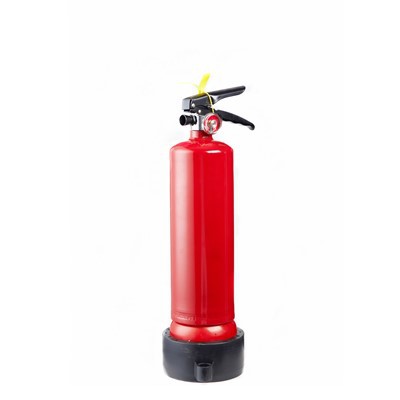
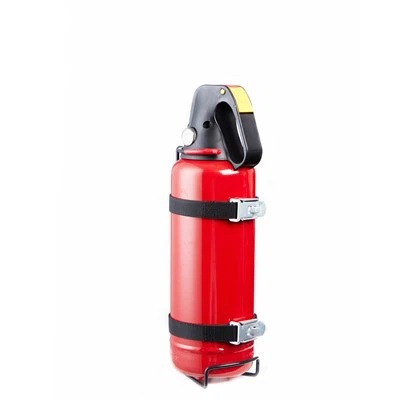
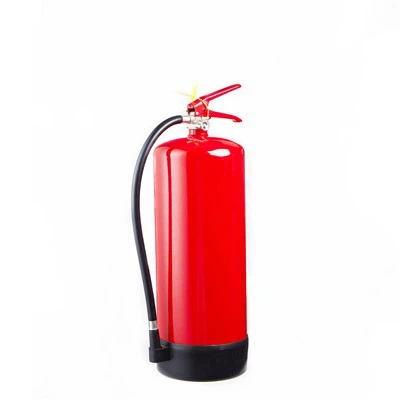
What is a water-based fire extinguisher?
Fire extinguishers, industrial products specifically designed to combat fires, primarily function to quickly extinguish, suppress, or effectively prevent the spread of fires.
Water-based fire extinguishers, with their unique extinguishing mechanism, have become crucial weapons in fire prevention and control. They contain an AFFF (Aqueous Film-Forming Fire) extinguishing agent that reacts with nitrogen to generate abundant foam. When this foam is sprayed onto the fuel surface, the water released from the foam layer spreads across the fuel, forming a dense water film. This water film effectively blocks the contact between the combustible material and the air, achieving rapid fire suppression.
Advantages of Water-Based Fire Extinguishers
Physical Extinguishing Mechanism: Water-based fire extinguishers emerged in the 1980s, their extinguishing mechanism based on physics. By forming and spreading a thin water film on the surface of the combustible material, they effectively isolate the combustible material from the air, thus achieving rapid fire suppression.
Dual Action: The fire extinguisher sprays a fine water mist through an atomizing nozzle, which not only diffuses the fire area and evaporates heat to lower the fire temperature, but also simultaneously reduces the oxygen concentration in the air of the combustion zone, effectively preventing reignition.
Self-rescue function: In addition to extinguishing fires, water-based fire extinguishers can also be used for self-rescue in a fire. When a fire breaks out, the agent can be sprayed on the body and applied to the head, providing complete flame protection for people in ordinary fires, and minimizing burns even in high-temperature environments.
Easy to use: No need to invert, long shelf life, resistant to reignition, and pollution-free. Suitable for precision instruments and equipment, leaving no corrosive residue.
Wide applicability: Water-based fire extinguishers are mainly suitable for initial fires involving solid materials, flammable liquids, electrical appliances, and kitchen grease. However, their effectiveness may be less than ideal for metal fires and fires caused by substances that react violently with water. Furthermore, they are unaffected by indoor or outdoor environments or strong winds, and can be used in homes, cars, and commercial offices.

How to use a portable water-based fire extinguisher
1.When using a portable fire extinguisher, quickly carry it by the handle to the fire location. Place the extinguisher approximately 5 meters from the fire (upwind when using outdoors). Then, pull out the safety pin (avoid pointing the extinguisher head towards people to prevent injury from ejection), grasp the tip of the nozzle, and press down firmly to spray the extinguishing agent. For fires involving spilled liquids, spray from the side of the flames towards the base, sweeping left and right while advancing quickly until the flames are extinguished.
When extinguishing fires involving flammable liquids inside containers, sweep left and right towards the base of the flames. Once the flames are drawn out of the container, quickly advance and extinguish any remaining fire. Avoid aiming the nozzle directly at the liquid surface to prevent splashing and spreading of the fire.
For fires involving solid materials, aim the extinguisher nozzle at the most intense part of the fire and sweep left and right, ensuring the dry powder extinguishing agent evenly covers the burning material until the fire is completely extinguished.
During use, keep the fire extinguisher upright, avoiding lying horizontally or upside down, to ensure proper spraying.
Next, we will discuss the composition of the extinguishing agent in water-based fire extinguishers. These components mainly include water, as the basis for cooling and extinguishing; surfactants, which reduce water tension and enhance penetration and wetting; flame retardants, which inhibit combustion reactions; and other additives such as antifreeze and preservatives to ensure the normal use and storage of the fire extinguisher in various environments.
In addition, the service life, refill life, and tank life of water-based fire extinguishers are also important information that users need to pay attention to.
The service life, refill life, and tank life of water-based fire extinguishers are all clearly defined. Their service life is typically 6 years. Under normal operating conditions, water-based fire extinguishers should undergo their first maintenance 3 years from the date of manufacture, and then be sent for maintenance again every year thereafter. If the operating environment or protection requirements change, the first maintenance time should be appropriately advanced, and the service life should be shortened accordingly. Furthermore, the service life of the steel cylinders for water-based fire extinguishers is 6 years.

According to the national mandatory standard "General Specification for Fire Protection Facilities" (GB 55036-2022), which came into effect on March 1, 2023, fire extinguishers should be scrapped under the following circumstances: excessive rust area on the cylinder or pitting on the surface; obvious deformation or severe mechanical damage to the cylinder; cracks in the head or lack of a pressure relief mechanism; unreasonable structural features, such as a flat-bottomed cylinder; portable fire extinguishers without an intermittent spray mechanism; the manufacturer's name and manufacturing date cannot be confirmed; traces of repair such as soldering, brazing, or patching on the cylinder; having been burned; and the manufacturing date reaching or exceeding the maximum scrapping period (i.e., 6 years).
During fire inspections, it is crucial to regularly check the appearance and pressure indicator of water-based fire extinguishers. If a fire extinguisher is found to have problems or has exceeded its prescribed service life, it should be immediately sent for repair or scrapped, and a new fire extinguisher should be promptly replaced to ensure its effectiveness and safety. At the same time, following the correct operating procedures for using fire extinguishers is also essential; only in this way can their fire-extinguishing effect be fully realized.
2. Carefully check the fire extinguisher's nameplate to ensure that the manufacturer, production date, model, and extinguishing agent type are clear, complete, and accurate.
3. Inspect the nozzle and spray gun for blockages, cracks, or deformation to ensure they are in good working order.
4. Carefully check the safety pin and lead seal for damage to ensure they are intact and functioning correctly.
Pressure check

Observe the pressure indicator needle position and ensure it is within the green zone, indicating normal pressure. If the needle is in the red zone, the pressure is too low, which may affect normal injection; while the yellow zone indicates excessive pressure, posing a safety hazard.
Inspection of fire extinguishing agents
Confirm that the extinguishing agent is within its expiration date and check for any sedimentation, stratification, or deterioration.At the same time, the operational performance of the fire extinguishers should also be checked:Conduct appropriate operational tests to check if the operating mechanism is flexible and if opening and closing are smooth.
Check if the installation location of the fire extinguishers meets the requirements.
1. Confirm that the fire extinguishers are installed in a clearly visible and easily accessible location, with no obstructions around them.
2. Check that the fire extinguishers are placed in the designated locations and ensure that the quantity complies with fire safety regulations.