Which Hose Reel Is Right for Industrial Applications?
Spring hose reels and manual hose reels both provide a controlled method of storing and deploying industrial hoses, but they use fundamentally different rewind mechanisms.
A spring hose reel uses stored mechanical energy to retract the hose automatically, while a manual hose reel relies on an operator turning a crank or handle to wind the hose back onto the drum.
The difference affects more than convenience. Hose weight, hose length, operating frequency, installation position, retraction force, maintenance requirements, and application environment all influence which configuration is more appropriate.
For industrial equipment buyers, the right question is not simply which reel is "better," but which rewind mechanism matches the actual hose and working cycle.
Spring Hose Reel vs Manual Hose Reel at a Glance
| Parameter | Spring Hose Reel | Manual Hose Reel |
|---|---|---|
| Rewind method | Stored spring energy | Hand crank/handle |
| Retraction | Automatic | Manual |
| External power | Not required | Not required |
| Operator effort | Low during retraction | Higher |
| Hose control | Automatic | Operator-controlled |
| Heavy hose suitability | Limited by spring torque | Generally more adaptable |
| Long hose suitability | Application-dependent | Often suitable |
| Retraction speed | Spring-controlled | Operator-controlled |
| Mechanical complexity | Higher | Lower |
| Maintenance | Spring and mechanism require inspection | Relatively simple |
| High-cycle operation | Generally advantageous | More labor-intensive |
| Precise manual control | Limited | High |
| Typical applications | Air, water, oil, grease, workshop service | Water, hydraulic, fuel, long/heavy hoses |
The table provides a general comparison. Actual suitability depends on the specific reel construction and hose specifications.
What Is a Spring Hose Reel?
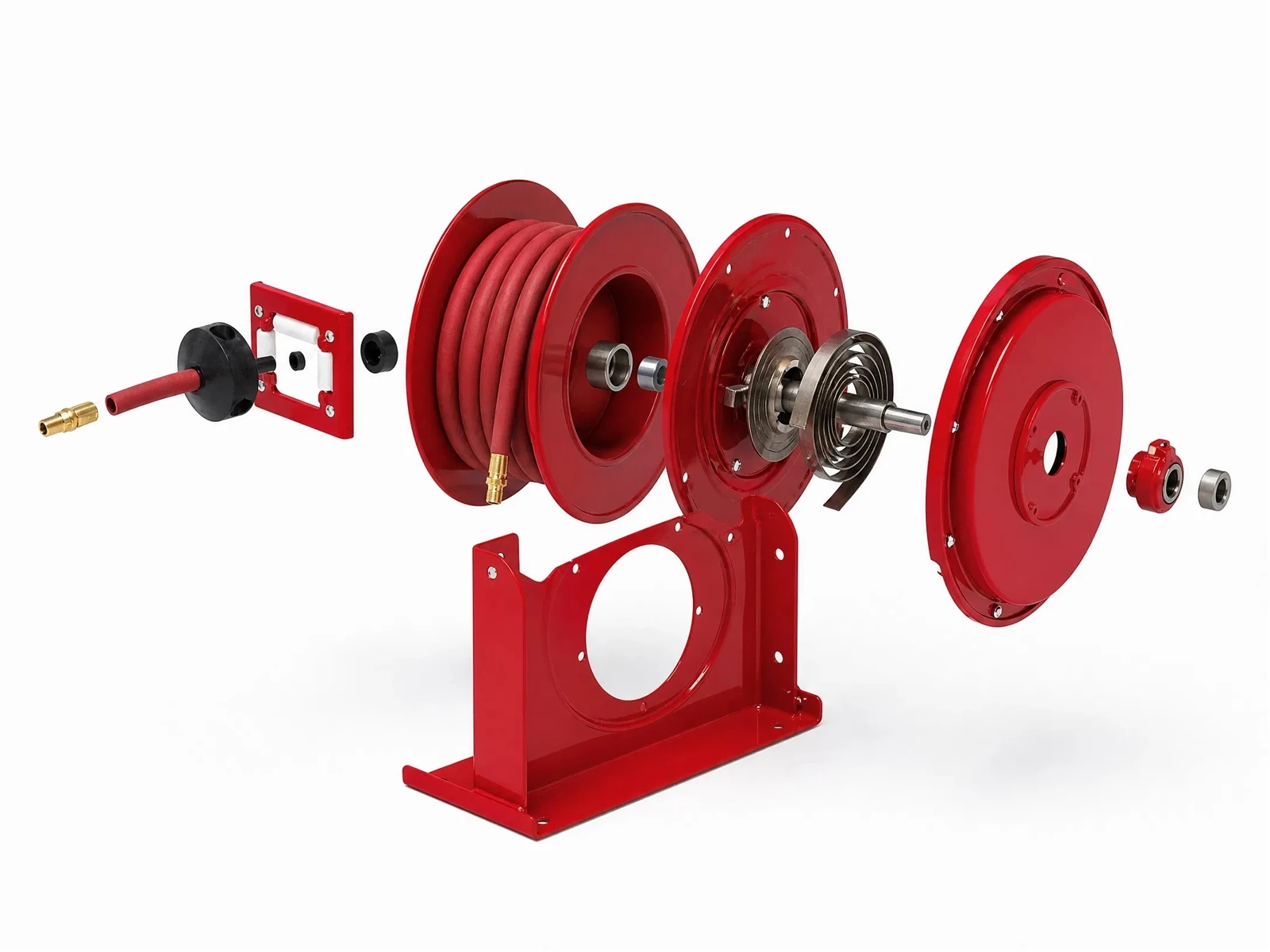
A spring hose reel uses a mechanical spring to provide the force required to rewind the hose.
The basic operating sequence is:
Pull hose → Drum rotates → Spring stores energy → Release/return → Spring rotates drum → Hose retracts
The spring is connected mechanically to the rotating drum. As the operator pulls the hose out, the drum rotates and increases the spring's stored energy.
When the hose is returned, the spring releases this energy and produces torque in the opposite direction.
No electric motor, hydraulic motor, or pneumatic drive is required.
Main Components
A typical spring hose reel includes:
- Drum
- Spring assembly
- Shaft
- Bearings
- Swivel
- Frame
- Hose guide
- Hose stopper
- Locking mechanism, where applicable
The spring is the defining component, but the performance of the complete reel depends on the interaction between the spring, drum radius, hose weight, and winding layers.
What Is a Manual Hose Reel?
A manual hose reel uses an operator-operated crank to rotate the drum.
The basic operating principle is:
Pull hose → Drum rotates → Use hose → Turn crank → Drum rotates → Hose winds back
The operator supplies the mechanical input instead of a spring.
A typical manual reel may include:
- Drum
- Shaft
- Crank
- Gear or transmission mechanism
- Bearings
- Swivel
- Frame
- Hose guide
- Mounting bracket
A geared crank can provide mechanical advantage, allowing the operator to rewind a hose that would be difficult to coil manually.
The Fundamental Difference: Where Does the Rewind Force Come From?
The most important distinction is the source of retraction force.
Spring Hose Reel
The energy comes from a preloaded mechanical spring.
Human force during deployment → Spring energy storage → Automatic retraction
Manual Hose Reel
The operator provides the energy during winding.
Human force → Crank → Mechanical transmission → Drum → Hose winding
This difference determines how much control the operator has and how much physical effort is required during each operating cycle.
Spring Hose Reel: Advantages
Automatic Retraction
The primary advantage is that the hose can retract without manually turning a crank.
After use, the operator can guide the hose toward the reel while the spring rotates the drum.
This is particularly convenient when the hose is deployed and retracted many times during a working shift.
Faster Hose Storage
Automatic retraction can reduce the time required to return the hose to its storage position.
This is useful in:
- Automotive workshops
- Manufacturing stations
- Equipment maintenance areas
- Cleaning stations
- Service bays
Reduced Operator Handling
The operator does not need to manually wind the complete hose length.
This can reduce repetitive manual work during high-frequency hose operation.
Compact Operation
Spring-driven mechanisms can provide automatic operation without requiring an external electrical, hydraulic, or pneumatic power source.
Spring Hose Reel: Limitations
Automatic retraction does not mean that a spring reel is suitable for every hose.
Spring Torque Limits
The spring must generate enough torque to retract the hose.
As hose length and weight increase, the required torque also increases.
A spring that is too weak may result in:
- Incomplete retraction
- Slow winding
- Hose remaining outside the reel
- Poor final-layer tension
A spring that is too strong can create the opposite problem:
- Excessive hose pulling force
- Difficult deployment
- Aggressive retraction
- Increased mechanical shock
Therefore, spring selection must be matched to the actual hose configuration.
More Mechanical Components
Compared with a basic manual reel, a spring reel contains an additional energy-storage mechanism.
The spring, locking mechanism, and related components require periodic inspection and appropriate maintenance.
Retraction Is Not Completely Free
Although the operator does not manually wind the hose, the spring mechanism still has to overcome:
- Hose weight
- Drum friction
- Guide friction
- Winding resistance
- Changes in winding radius
This is why hose weight is a critical parameter when selecting a spring reel.
Manual Hose Reel: Advantages
High Operator Control
The operator controls the winding speed directly through the crank.
This can be useful when the hose needs to be retracted gradually or positioned carefully.
Suitable for Long or Heavy Hoses
A manual reel can use a crank and gear ratio to provide mechanical advantage.
Instead of requiring the operator to lift and coil the hose directly, the crank transfers the input force through the mechanical system.
For certain long or heavy hose assemblies, this can be more practical than trying to match a very large spring.
Simple Mechanical Construction
A manual reel does not require a spring energy-storage system.
Its basic mechanical architecture can be relatively straightforward:
Crank → Shaft/Gear → Drum
This can simplify inspection, servicing, and hose replacement.
No Spring Tension During Deployment
Unlike a spring reel, a manual reel does not continuously apply spring torque to the drum while the hose is being pulled.
This can provide a different operating feel and greater control for certain applications.
Manual Hose Reel: Limitations
Requires Operator Effort
The main disadvantage is obvious: the hose must be manually rewound.
For a hose used occasionally, this may be insignificant.
For a hose deployed dozens or hundreds of times per day, however, repeated crank operation can become a significant operational burden.
Slower Retraction
The actual retraction speed depends on the operator's crank speed and the mechanical transmission.
This can be advantageous for controlled winding but disadvantageous where rapid hose return is required.
Operator-Dependent Winding
The quality of hose storage can depend more heavily on how the operator uses the crank and guide.
Poor winding technique can cause uneven layers or localized accumulation on the drum.
Which Is Better for Frequent Hose Use?
For high-frequency hose deployment and retraction, a spring hose reel is generally more convenient.
Consider a workstation where an operator repeatedly uses a compressed-air hose throughout the day.
With a spring reel:
Pull → Use → Release/guide → Retract
With a manual reel:
Pull → Use → Walk back → Turn crank → Wind hose
The difference becomes increasingly significant as the number of operating cycles increases.
For occasional use, however, the productivity advantage of automatic retraction may not justify the additional mechanical complexity.
Which Is Better for Heavy Hoses?
This question requires more careful analysis.
A heavy hose does not automatically require a manual reel.
Instead, determine the total hose weight and required rewind torque.
For a spring reel, the spring must overcome the hose's weight and winding resistance.
For a manual reel, the operator supplies the input force, which can be mechanically multiplied through the crank or gear system.
As a result:
- Moderately heavy hose + frequent operation: a properly sized spring reel may work well.
- Very heavy hose + occasional operation: a manual reel may be more practical.
- Very heavy hose + frequent operation: a motorized reel may be worth considering.
Therefore, the choice should not be based solely on the word "heavy-duty."
Spring Reel vs Manual Reel for Long Hoses
Hose length affects both configurations.
As hose length increases:
- Total hose weight increases.
- Required drum capacity increases.
- Multiple winding layers become more likely.
- Drum torque requirements change.
- Storage dimensions increase.
For a spring reel, the spring must maintain sufficient torque across the hose's operating range.
For a manual reel, the crank mechanism must provide manageable winding torque.
A long hose therefore requires a complete mechanical evaluation rather than selecting a reel based only on nominal length.
How Does Hose Diameter Affect the Choice?
Both hose ID and OD matter, but they affect the reel differently.
Hose ID
Primarily affects:
- Flow rate
- Pressure loss
- Connection size
- Swivel passage
Hose OD
Primarily affects:
- Drum capacity
- Number of winding layers
- Reel dimensions
- Hose weight
- Rewind requirements
A larger OD generally means a larger storage volume and greater hose mass.
For spring reels, this can significantly affect spring torque requirements.
For manual reels, it increases the effort required at the crank.
Spring Reel vs Manual Reel for Air Hose
For compressed-air applications, spring reels are commonly advantageous when the hose is used frequently at fixed workstations.
Typical applications include:
- Pneumatic tools
- Assembly stations
- Automotive repair
- Manufacturing workshops
- Maintenance areas
Automatic retraction keeps the hose away from the working floor when not in use.
A manual air hose reel can still be appropriate where the hose is long, used infrequently, or where the operator prefers direct winding control.
The key parameters remain:
- Air pressure
- Hose ID
- Hose OD
- Hose length
- Connection size
- Flow requirement
Spring Reel vs Manual Reel for Water
Water applications can use either configuration.
A spring-driven water reel is convenient for:
- Factory washdown
- Vehicle cleaning
- Maintenance stations
- Frequent cleaning operations
A manual water reel may be preferable for:
- Long hoses
- Agricultural irrigation
- Large outdoor service areas
- Occasional operation
For outdoor installations, material and corrosion resistance may become more important than the rewind method itself.
Spring Reel vs Manual Reel for Hydraulic Hose
Hydraulic applications require more detailed consideration.
A hydraulic hose can be relatively heavy and may operate under high pressure. The reel must accommodate:
- Hose pressure rating
- Hose weight
- Minimum bend radius
- Hose OD
- Swivel rating
- Fitting configuration
- Pressure spikes
- Operating frequency
A spring-driven hydraulic reel can be useful for relatively manageable hose assemblies that require frequent automatic retraction.
For heavier hydraulic hoses, manual or powered reels may provide a more appropriate mechanical solution.
The reel must never compromise the hydraulic hose's specified minimum bend radius.
Spring Reel vs Manual Reel for Grease
Grease delivery often involves high-pressure service and comparatively heavy hoses.
For grease hose reels, the pressure path should be evaluated as:
Supply → Swivel → Hose → Fitting → Grease gun/application point
The pressure rating of the reel assembly must be appropriate for the intended system.
For a lighter grease hose used frequently, a spring-driven configuration can provide convenient automatic retraction.
For long or heavy grease hoses, a hand-crank configuration may provide better control over winding force.
How Does Installation Position Affect the Choice?
Mounting orientation can change the mechanical load experienced by the reel.
Common configurations include:
- Wall-mounted
- Ceiling-mounted
- Floor-mounted
- Vehicle-mounted
- Machine-mounted
For a wall-mounted spring reel, the spring must retract the hose while overcoming the relevant hose weight and friction.
For a vehicle-mounted reel, vibration and shock loads must also be considered.
Manual reels can sometimes be easier to adapt to demanding mobile applications because the operator directly controls the winding process.
However, a powered reel may be more appropriate when both hose weight and operating frequency are high.
Spring Reel vs Manual Reel for High-Cycle Applications
Operating frequency is one of the strongest factors favoring a spring reel.
Consider two applications.
Application A
- 10 m air hose
- Used 5–10 times per day
- Indoor workshop
- Lightweight hose
A manual reel may be completely adequate.
Application B
- 15 m air hose
- Used continuously throughout the working shift
- Multiple operators
- Hose deployed and retracted hundreds of times
A spring reel is generally more convenient because automatic retraction eliminates repeated crank operation.
The correct choice therefore depends not only on technical capacity but also on the number of operating cycles.
Maintenance Differences
The two reel types also have different maintenance considerations.
Spring Hose Reel
Inspection should typically include:
- Spring mechanism
- Bearings
- Swivel
- Hose
- Hose guide
- Locking mechanism
- Mounting structure
The spring should not be treated as a user-adjustable component unless the reel manufacturer specifically provides an adjustment procedure.
Manual Hose Reel
Maintenance typically focuses on:
- Crank
- Shaft
- Gears
- Bearings
- Swivel
- Hose
- Hose guide
- Mounting structure
The manual mechanism generally has fewer energy-storage components, although gear and shaft wear still need to be monitored.
Spring Hose Reel vs Manual Hose Reel: Cost Should Not Be the Only Criterion
The initial purchase price is only one part of the selection decision.
The more useful comparison is:
Initial equipment + operator effort + operating frequency + maintenance + hose management requirements
For occasional use, a manual reel may provide sufficient functionality without the additional spring mechanism.
For high-frequency operation, automatic retraction can provide operational value by reducing repeated manual winding.
The objective should therefore be to select the simplest reel that adequately satisfies the operating requirements.
A Practical Selection Matrix
| Application Condition | Recommended Direction |
|---|---|
| Short, lightweight hose | Spring reel |
| Frequent daily operation | Spring reel |
| Fixed workstation | Spring reel often suitable |
| Long hose | Manual or powered reel may be suitable |
| Heavy hose | Manual or powered reel may be preferable |
| Need controlled winding speed | Manual reel |
| No external power available | Spring or manual |
| High-cycle air service | Spring reel |
| Occasional water service | Either |
| Heavy hydraulic hose | Manual or powered, depending on load |
| Heavy grease hose | Manual or powered, depending on pressure and weight |
| Mobile service equipment | Manual, hydraulic, or electric depending on duty |
| Automatic retraction required | Spring reel |
This is a starting point rather than a substitute for checking the actual hose specifications.
Five Questions to Ask Before Choosing
Before selecting between a spring hose reel and a manual hose reel, determine:
How long is the hose?
Longer hoses increase storage capacity and rewind requirements.
How heavy is the hose?
Hose weight directly affects spring torque or manual crank effort.
How often is the hose used?
High-cycle applications benefit more from automatic retraction.
How much control does the operator need?
If controlled winding speed and positioning are important, manual operation may have an advantage.
What medium and pressure does the hose carry?
The swivel, fittings, hose, and reel must be compatible with the operating medium, pressure, and temperature.
When Should You Choose a Spring Hose Reel?
A spring hose reel is generally a strong choice when the application requires:
- Automatic hose retraction
- Frequent hose deployment
- Reduced operator handling
- Compact hose storage
- No external power
- Fixed workstation operation
- Moderate hose weight
- Quick return to the stored position
Typical examples include compressed-air tools, factory cleaning stations, service bays, and general maintenance points.
When Should You Choose a Manual Hose Reel?
A manual hose reel is generally worth considering when the application requires:
- Direct operator control
- Long hose storage
- Heavy hose handling
- Occasional operation
- Gradual retraction
- Simple mechanical construction
- No automatic rewind requirement
Typical examples include long water hoses, agricultural systems, mobile service equipment, and selected heavy-duty industrial applications.
What If Neither Spring nor Manual Is Suitable?
There are applications where neither mechanism is the best solution.
For very long, heavy, or frequently operated hoses, a motor-driven hose reel may be more appropriate.
Possible drive methods include:
- Electric motor
- Hydraulic motor
- Pneumatic motor
This is especially relevant for mobile service equipment, large hydraulic hoses, heavy grease delivery systems, and high-cycle industrial operations.
The selection logic can therefore be summarized as:
Light/moderate hose + frequent use → Spring
Long/heavy hose + controlled occasional use → Manual
Heavy hose + frequent operation → Powered reel
Conclusion
The difference between a spring hose reel and a manual hose reel is fundamentally the difference between automatic mechanical retraction and operator-controlled winding.
A spring hose reel stores energy during hose deployment and uses that energy to retract the hose. It is particularly useful for repetitive operations where reducing manual handling and returning the hose quickly are important.
A manual hose reel uses a crank to rotate the drum. It requires more operator involvement but provides direct control and can be well suited to long, heavy, or occasionally used hoses.
The correct choice should be based on:
Hose length + hose OD + hose weight + minimum bend radius + working pressure + medium + operating frequency + installation position
In practical industrial applications, there is no universal winner. Spring reels are generally favored for convenience and high-cycle operation, while manual reels provide greater direct control and can be more practical for long or heavy hose assemblies. When the hose load becomes too high for either approach, a motor-driven reel may be the more appropriate engineering solution.